Redefining Revenue Management in Hospitality: Insights from the HSMAI MEA Executive Roundtable
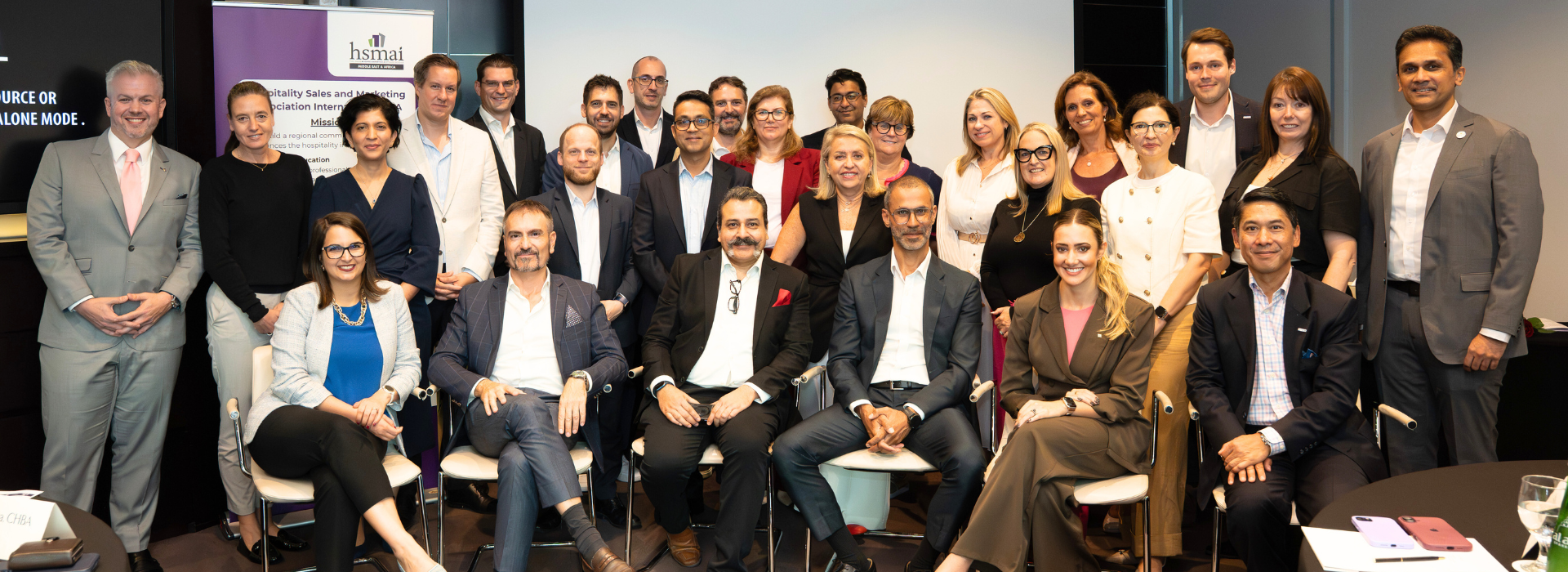
The revenue management function in hospitality is undergoing its most significant transformation in decades. At HSMAI Middle East & Africa’s Executive Roundtable on Revenue Management, hosted in partnership with Agilysys and FLYR Hospitality, senior commercial and revenue leaders came together to explore the forces reshaping the discipline, from the rise of ancillary revenue and personalization to the growing influence of AI.
The discussion was co-facilitated by Judith Cartwright, CRME, CHBA, CEO of Black Coral Consulting, and Dr. Mahala Geronasso, Ph.D., MBA, Lecturer in Hospitality Finance and Accounting at Les Roches Abu Dhabi. Together, they lead an insightful exploration of the evolving role of revenue leaders in today’s hospitality landscape.
The session was co-sponsored by Agilysys and FLYR Hospitality, featuring two powerful keynote presentations:
“From RevPAR to RevPAG: Unlocking Total Guest Value to Elevate Hotel Revenue” – highlighting the shift toward holistic guest monetisation and total profit optimisation, by Praveen Paul, VP Sales, Agilysys.
“12 Months of Change, 12 Months Ahead” – showcasing how artificial intelligence is transforming forecasting, pricing, and decision-making across the hospitality industry, by Leopold Barrit, VP Sales and Fabian Prinz, Director Sales, FLYR Hospitality.
Beyond Room Revenue
The session opened with a keynote by Agilysys, centered on the theme “Beyond Room Revenue,” a call to rethink how hotels define and measure value.
According to HSMAI’s Ancillary Revenue Playbook (2025), “ancillary revenue is no longer a side stream — it’s the new front line of profitability.” Hotels generating more than 40% of revenue from non-room sources outperform peers in GOP margin by up to 15%.
A typical full-service hotel earns about 65% of total revenue from rooms and 35% from ancillary streams, according to HotStats (2024), with the highest-ROI categories including F&B, spa and wellness, early check-in & late check-out, parking & transfers, and retail & recreation.
The discussion emphasized a strategic move from RevPAR (revenue per available room) to RevPAG (revenue per available guest), highlighting a new focus on holistic guest monetization rather than unit efficiency. HSMAI encourages hotels to shift from rate-centric to guest-centric revenue models.
As one participant noted, “What we measure defines what we see.” By tracking total guest value instead of departmental outputs, revenue leaders can align teams around total profit rather than room-only performance.
Personalisation as a Revenue Strategy
Participants agreed that personalization has evolved beyond a marketing concept and that it is now a revenue strategy. The challenge, however, lies in execution. Aging and fragmented tech stacks, mixed guest profiles, siloed systems, and the absence of a unified identifier continue to impede progress toward true personalization.
The Agilysys presentation described the “hospitality holy grail,” a unified guest profile that connects data across booking engines, F&B, spa, and operations. Only one in four hotels currently measures ancillary conversion or revenue per guest across the full journey. As guests increasingly expect real-time access to experiences, the opportunity is clear: deliver personalization at scale by connecting every revenue stream.
“Revenue leaders acknowledge that 20–40% of guest-spend potential goes untracked due to siloed systems.”— HSMAI Ancillary Revenue Playbook, 2025
Distribution in a Fragmented Marketplace
A dynamic discussion unfolded around channel and distribution strategy. Leaders debated whether hotels are truly optimizing channels or merely “managing noise.” Approaches ranged from closing out premium categories during high-demand periods to driving direct bookings through brand.com. Others advocated maintaining visibility across OTAs via dynamic pricing, rather than static rate closures.
A recurring theme was the need to shift internal KPIs from volume of partners to profit per partner, and to bring transparency to owners on the rationale behind revenue strategies. As one participant summarized, “We need to talk about commercial success for the whole property, not just channel share.”

The AI Acceleration: 12 Months of Change
In the second keynote, FLYR Hospitality presented “12 Months of Change – 12 Months Ahead,” positioning AI as the tipping point for the next era of revenue management.
Over the past year, AI adoption among major hotel groups has doubled, with forecast updates moving from daily to hourly and AI-driven pricing gaining broad acceptance. Leading operators now allow AI systems to act autonomously for low-risk decisions, marking a shift from experimentation to operational deployment.
Real-world case studies showcased tangible impact: a regional hotel chain saw a 5% revenue uplift within 60 days and achieved 90% forecast accuracy after 30 days of AI learning. The next frontier, according to FLYR, extends AI applications beyond rooms to F&B, meetings, and even parking, driving multi-objective optimization across profit, occupancy, and sustainability.
But the gap between leaders and laggards is widening. Those clinging to manual overrides and spreadsheet-based workflows risk falling behind. “Standing still has a cost,” the presentation warned, not only in lost margin but also in talent retention, as professionals gravitate toward tech-forward organizations.
Shifting Guest Behaviour and Pricing Implications
The roundtable also explored evolving guest behaviour with shorter booking windows, more flexible bookings and increased cancellations becoming the norm. Visa processes and macroeconomic uncertainty continue to disrupt booking patterns. Meanwhile, redemption trends reveal an upmarket shift for longer stays and a trade-down for short breaks.
Revenue leaders noted that bundled value offers and non-refundable rates are increasingly effective in curbing cancellations. In parallel, alternative payment models like Tabby are gaining popularity, particularly in regional markets. The takeaway: pricing structures must adapt not just to market conditions but to behavioural economics.
The Road Ahead
As the industry transitions from RevPAR to RevPAG, and ultimately to GOPPAG (gross operating profit per available guest), the focus is clear: move from selling rooms to monetizing relationships. Future-ready revenue leaders are those who measure, integrate, and incentivize around total guest value while empowering AI to drive decision-making by exception.
Key Takeaways
- Beyond rooms: Ancillary revenue is a strategic pillar, not a side stream
- Personalization drives profit: Connect every touchpoint to achieve personalization at scale
- AI is the differentiator: The next 12 months will separate early adopters from laggards
- Data integration is essential: Unified guest profiles unlock the next wave of revenue growth
- Measure what matters: Shift from RevPAR to RevPAG and from rooms to relationships
Click here to view all the action.